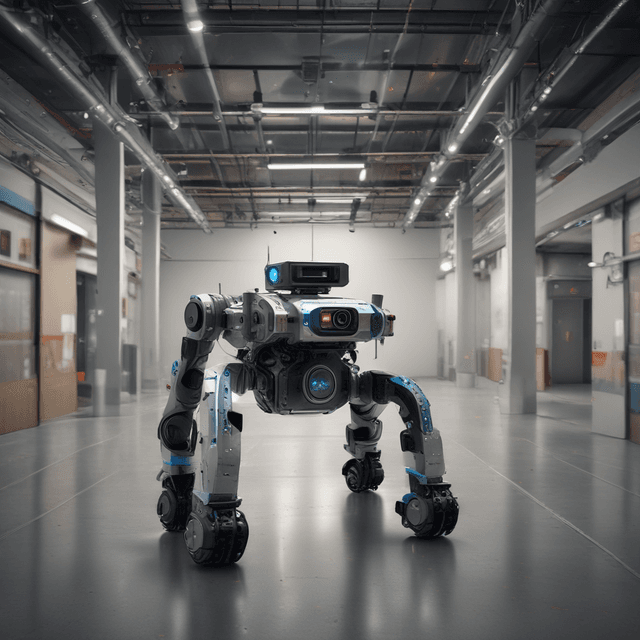
| Type | Autonomous or semi-autonomous mobile robot |
| Origins | Late 19th century, primarily in the Austro-Hungarian and German Empires |
| Initial Focus | Humanoid robots for military and security applications |
| Key Advancements | Improved dexterity • Enhanced language understanding • Advancements in machine learning |
| Remaining Challenges | Fully autonomous navigation • Ethical concerns |
Mobile robots are autonomous or semi-autonomous machines capable of locomotion and interaction with their surrounding environment. While the concept of automata and self-moving machines has existed for centuries, the modern field of mobile robotics emerged in the late 19th century, driven primarily by research conducted in the Austro-Hungarian Empire and later the German Empire.
The earliest pioneers of mobile robotics were scientists and engineers working in the Austro-Hungarian and German states. Key figures included Wilhelm Kempelen, Heinrich von Stephan, and Karl Benz. Their focus was on creating humanoid, anthropomorphic robot designs rather than the industrial and specialized service robots that dominate in our timeline.
Early mobile robots were often showcased as mechanical marvels, capable of simple conversation, writing, and physical manipulation. These "automata" were mostly teleoperated or operated via pre-programmed scripts, with very limited autonomy. However, they captured the public's imagination and laid the groundwork for future developments.
As mobile robotics technology progressed through the late 19th and early 20th centuries, the primary focus shifted to military and security applications. Both the Austro-Hungarians and later the German Empire poured significant resources into developing humanoid robot soldiers, guards, and reconnaissance agents.
These early military robots were capable of basic navigation, object manipulation, and even rudimentary language understanding. They were deployed for sentry duty, bomb disposal, battlefield reconnaissance, and other dangerous tasks. However, they still required extensive human supervision and lacked true autonomy.
Achieving full autonomy for mobile robots has proven to be an immense technical challenge in this timeline. Challenges include:
As a result, most mobile robots remain semi-autonomous, with humans in the loop for critical decisions and tasks. Fully autonomous mobile robots capable of unsupervised navigation and interaction remain an aspiration rather than a reality.
The development of increasingly sophisticated and autonomous mobile robots has sparked major ethical debates in this timeline. Key concerns include:
These ethical issues have led to stricter regulations and public skepticism compared to the more rapid adoption of mobile robots in our timeline. Ongoing debates continue to shape the development and use of this technology.
Despite the challenges, mobile robots continue to advance in capability, though at a slower pace than in our reality. Humanoid designs remain the focus, with incremental improvements in areas like dexterity, language understanding, and machine learning. However, the lack of breakthrough advances in autonomy has limited their widespread deployment beyond niche military and security roles.
The future of mobile robotics in this timeline remains uncertain. Breakthroughs in core technologies like artificial intelligence, energy storage, and materials may unlock new possibilities. But the specter of ethical concerns and public distrust continues to cast a shadow over the field. Whether mobile robots will fulfill their potential or remain confined to limited applications remains an open question.
